


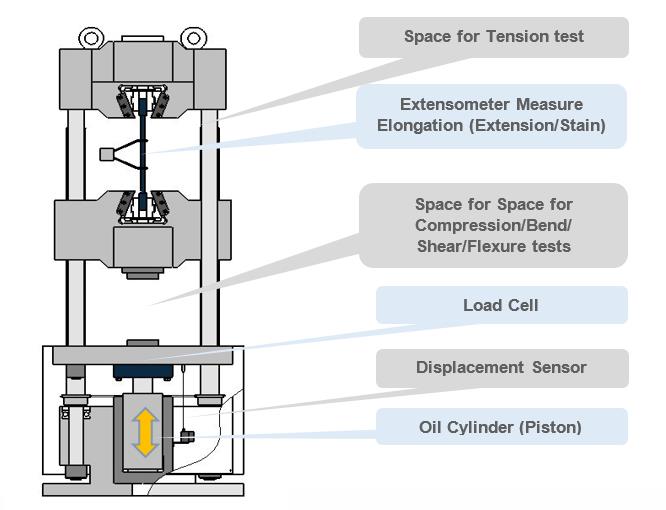
A tensile testing machine, also known as a universal testing machine (UTM), is a device used to test the mechanical properties of materials under tension. The primary purpose of the machine is to determine how a material behaves when a force is applied to it, specifically measuring its tensile strength, elongation, and Young's modulus. Here's a detailed description of its main components and functionality:
Main Components
-
Load Frame:
The structure that houses all other components. It is typically a robust, vertical frame designed to withstand high forces.
-
Crosshead:
A movable component that can be adjusted vertically. It is connected to the loading mechanism and applies the tensile force to the specimen. The crosshead can be motor-driven or hydraulically driven.
-
Grips or Fixtures:
Devices that hold the test specimen in place. These can vary depending on the material and shape of the specimen (e.g., flat grips for sheet materials, round grips for rods, etc.).
-
Load Cell:
A sensor used to measure the force applied to the specimen. It converts the mechanical force into an electrical signal that can be read by the control system.
-
Extensometer:
An optional accessory that measures the elongation or strain of the specimen directly. This can provide more precise data on how the material deforms under tension.
-
Control and Data Acquisition System:
The system that controls the movement of the crosshead, records data from the load cell and extensometer, and processes the data for analysis. It usually includes software to display and analyze the test results.
Functionality
-
Preparation:
The specimen is prepared according to specific standards (e.g., ASTM, ISO) to ensure consistent and reliable results. The specimen is then mounted between the grips or fixtures of the machine.
-
Testing:
The test begins with the crosshead moving at a controlled rate to apply a tensile force to the specimen. The rate of movement and the applied force are carefully controlled and measured.
As the force is applied, the load cell measures the amount of force, and the extensometer (if used) measures the elongation of the specimen.
-
Data Collection:
The control system collects data from the load cell and extensometer, recording the force applied and the corresponding deformation of the specimen.
This data is used to create a stress-strain curve, which provides valuable information about the material's properties, such as yield strength, ultimate tensile strength, and Young's modulus.
-
Analysis:
After the specimen fractures or the test is completed, the data is analyzed to determine the mechanical properties of the material. The stress-strain curve is particularly useful for understanding the material's behavior under tensile loads.
Tensile testing machines are used in various industries, including:
-
Materials Science:
To characterize new materials and compare the properties of different materials.
-
Quality Control:
To ensure that materials meet specific standards and specifications.
-
Research and Development:
To develop new materials and improve existing ones.
-
Engineering:
To design components that can withstand specified loads and deformations.